
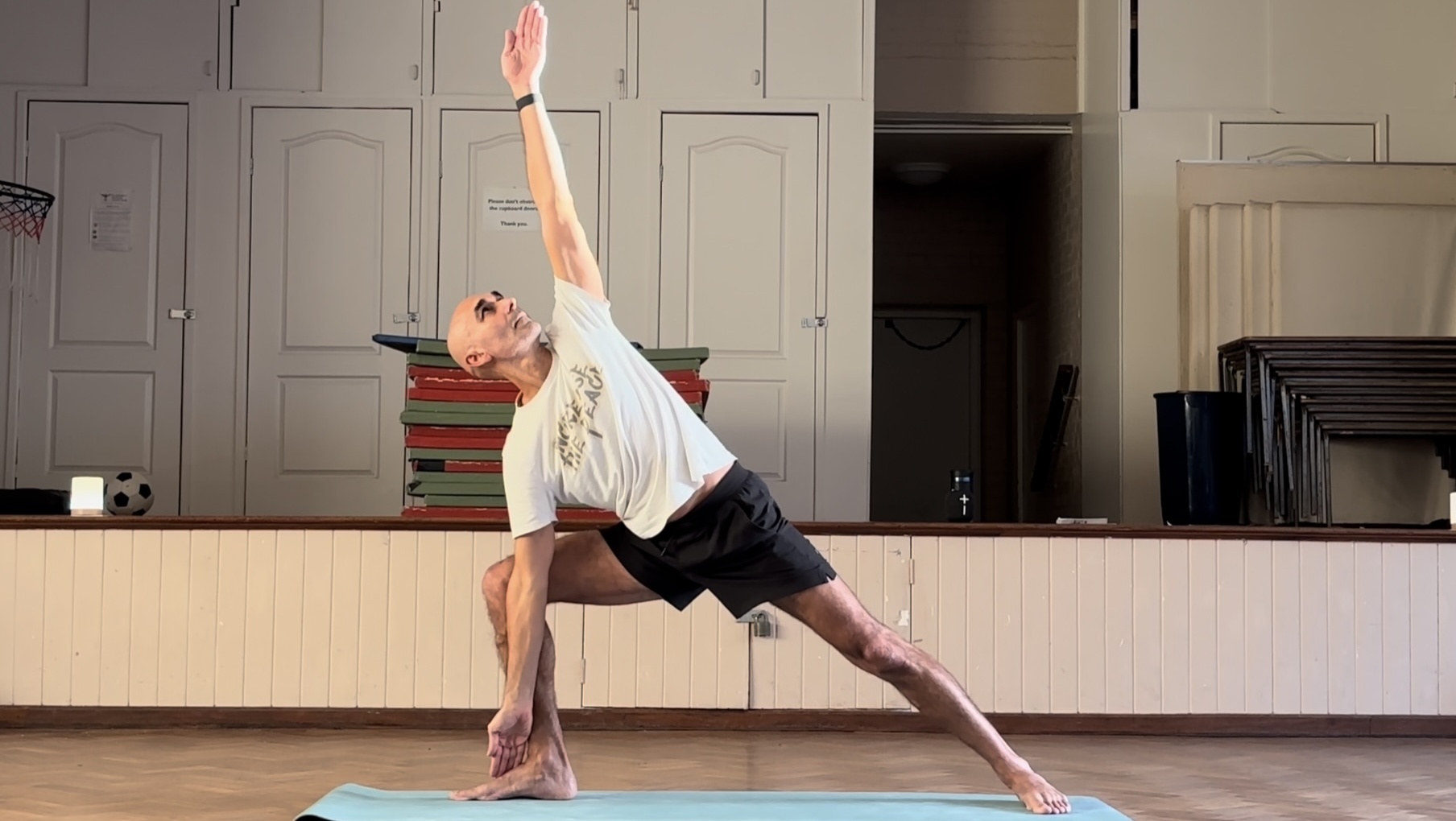
I started studying Yoga Sangraha through the Yoga Education Collective in 2022, initially looking to refresh my perspective on yoga studies and deepen my understanding of breathing practices after Covid.
Yoga Sangraha itself is a carefully designed collection of sequences assembled by Eddie Stern after years of study and experimentation with classical Hatha Yoga texts.
The Yoga Education Collective (YEC), is a school for online courses and teacher trainings founded by Eddie, Robert Moses and Harshvadhan Jhaveri, with the purpose to teach and preserve classical yoga practices.
For the last 18 years, I’ve been doing Mysore Ashtanga self-practice. I have a full-time job, I’m a parent and I teach yoga. Trying to do intense, dynamic practice needs to be managed carefully, and without constant attention to my energy levels, I was often left depleted or overstimulated – not ideal for the calm, balanced headspace I looked for in yoga.
The Pranayama and Yoga Sangraha techniques learned through YEC have helped revitalise my love of yoga practice and philosophy, and have given me the tools to regulate and monitor my nervous system. It’s a contemporary, science-informed approach, free from the dogmatic weight of the guru-lineage model.
Yoga Today
In today’s yoga landscape, many classes focus on skill-based experiences and aesthetic form. Traditional yogic language is often replaced by contemporary terminology that is easier to market, while interest in physical training methods such as Pilates and calisthenics continues to grow.
In that environment, classical yoga can sometimes feel distant from modern practice.
Yoga Sangraha
Yoga Sangraha (meaning Collection or Compendium) stands as a practice deeply rooted in tradition. It uses yogic terminology and the Sanskrit names for postures, and while not a new style of yoga (practices are collected from many lineages and Indic traditions) it presents them in a clear structure that demonstrates the primary aims of asana: to strengthen and stabilize the body and regulate the nervous system. More than this, the practice looks to show how yoga and its components work to do this, rather than just how to do the postures.
Sequences and Class Types
The sequences are taught across three main class types, each offering a unique emphasis. These groups of postures are not rigidly fixed; they are modular and may be moved or broken up depending on level and time:
- Yoga Sangraha Level 1 or Level 2 (L1 or L2): Groups of postures sequenced to start with focus, slowly ramp up in energy then gently down to rest.
- Sun Salutations Class: This class focuses on multiple variations of sun salutations. A dynamic and energising class.
- Yoga and Strength: A mix of yoga asana and body-strength work. Includes Sun salutations, dynamic push-up exercises, squats, lunges, and core work, plus some static asana, back strengthening and focused relaxation.
For reference a downloadable PDF of Sangraha L1 is available via this link: https://yogaeducationcollege.com/courses/yoga-sangraha/ (click on the materials tab)
The main groups of postures are configured to be alternately focusing, energising, calming, grounding, stimulating, balancing and resting.
- Lying down postures
- 5 directions of spine*
- Sun Salutations and Dands**
- Standing Asanas
- Forward bending (seated)
- Inversions
- Backbends (with plank variation counter-poses)
- Headstand/Arm balances
- Seated asana with breathing/Pranayama
- Relaxation
*Panca Merudana Kriya (5 directions of spine)
Similar practices are found in many lineages; these ones are from the Sukshma Vyayama (subtle body practices) popularized by Dhirendra Brahmachari. They help engage hamstrings and posterior chain of muscles and prepare body for dynamic movements.
**Sun Salutation variations
There are around 12 variations or more that can be practiced, none of which include the Surya Namaskar A and B practiced in Asthanga.
Some of these are new, others from Hatha yoga traditions, and others include versions of Dands and Baitaks (squats) from the Hindu wrestling tradition of Kushti. They are a super fun, progressive way to move into dynamic practice.
While the group types may not seem that different from any yoga class in structure, it includes some interesting asana versions. There are also key elements that anchor ashtanga-based methods that are not included here.
Where’s my Drishti?
- Vinyasa – Yoga Sangraha is not vinyasa yoga in the modern sense, where postures are seamlessly connected through continuous transitions. However, movements and breath remain connected in a natural, logical manner.
- Ujjayi – While Ujjayi breathing involves creating a sound by narrowing the throat, asana practice here avoids any forced or tense breathing.
- Bandha – The method does not incorporate deliberate application of bandha (internal locks) during asana.
- Drishti – Unlike Ashtanga, where drishti (a fixed gaze point) is mapped out for each posture, this system does not strictly prescribe such focus at all times. Practitioners may even have the option to close their eyes during some postures.
- Physical Assists – Minimal to no hands-on adjustments, allowing one to explore the postures independently. Small cues are given so that students can understand how to make their own adjustments and truly feel the asana and how it affects them.
Throughout the practice, it is important for the breath to remain smooth and even. Attention should be centred on the natural movement of the belly, which helps maintain a calm and steady experience during asana.
It is not disputed that Drishti, bandha and physical adjustments work for many people in other methods. Yoga Sangraha only offers an alternative container for experimentation.
Who is it for?
Yoga Sangraha works for complete beginners or experienced practitioners. It can be used just as a modern, fun and accessible movement practice or a safe and non-competitive environment for the practice of asana. You can also pick the elements you like and add them into your own practices or teaching.
Personally, I continue to study Ashtanga with my teacher Corrie at Mission, where I can also explore pranayama and mediation within the Mysore room. At home or when travelling, I now mainly do Yoga Sangraha or experiment with other Hatha yoga practices.
Yoga Sangraha encourages a subtle shift in perspective. Instead of focusing on how well a posture is performed, attention turns toward why we practise and what the practice is doing.
Without the pressure of performance, this may create more space for other elements of yoga study such as philosophy and meditation, or simply allow our attention to return to where it is most needed: work, family and the present moment of life.
—
Eddie Stern is coming to Mission 10th -12th April – Booking and info here
—
Amit Singh
Amit first discovered Ashtanga yoga in 2008 and travelled to Mysore, India, in 2011 to begin studying at the KPJAYI Ashtanga Yoga Institute. He has returned for seven seasons since and received Authorization from the late Sharath Jois in 2017. Since 2021, his studies have focused on Pranayama and Yoga Sangraha under Eddie Stern and Robert Moses, while also continuing his daily practice of the Advanced A Series of Ashtanga yoga with his teacher Corrie.